
OWNER ANSWER
BYD SEAL alarm going off after locking? Identify the alert first
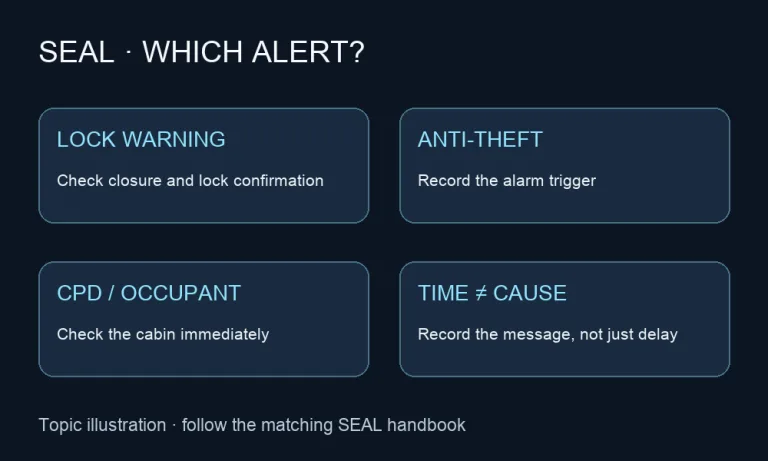
If your SEAL alarm sounds after locking, check the cabin immediately and use the valid physical key to unlock. Then check the actual message: Child Presence Detection, a closure warning and the anti-theft alarm need different checks.
- Check that everyone is out and safe.
- Use the valid physical key or open a door as instructed to cancel a CPD alert; the cited handbook says app unlocking cannot cancel it. Safety note: Check the cabin yourself: CPD can miss someone and its climate response may be unavailable. Never leave a child, vulnerable person or animal inside to test it, and leave hardwired security equipment and sensors to the installer.
- Switch off normally and check door, boot and bonnet closure indications.
- With the cabin empty, make one normal physical-fob locking comparison.
- Check lock confirmation, the arming indicator and any named CPD/app alert.
What to expect
Normal locking confirms the car is secured and the empty-cabin alert does not repeat. If it does repeat, the named alert and timing guide the investigation; do not keep triggering it.
If that did not work
If the alarm repeats after the ordinary empty-cabin/closure check, stop provoking it and ask BYD for the trigger investigation above. If it cannot be secured, agree a safe supervised solution or assistance rather than leaving it unlocked.
What to note down for support: Full build/generation, named alert, lock confirmation, delay, frequency and recent work help the repairer.
A beep is different from sustained honking
A single lock-warning beep can indicate an open closure or locking with ignition on. The original handbook describes anti-theft arming after about 10 seconds and an initial locked-car CPD alert within about 10 seconds. Timing alone does not identify the trigger.
Software changes the CPD timing
The reviewed original-SEAL 2.3.0 release changes the initial locked-car CPD delay from 10 to 90 seconds and remembers an OFF choice. Older EN-250305 instructions instead reset CPD at startup. Match generation and full build rather than applying an older timing to every SEAL.
Accessories and owner-reported dealer work
Tell the repairer about recent OBD equipment, tracker/dashcam wiring, door/bonnet work or an update. Owners have reported alarm interactions with OBD equipment and dealer work referred to as P2P. One newly delivered Excellence report lacks exact model year/build; another had work alongside 2.3.0. Keep those reports as leads for an exact-car technical case, not proof that 2.3.0 or a particular accessory is the cure.
Ask for the trigger, not a guess
Ask which alarm system triggered, whether its last event can be retrieved, and whether the corresponding closure/sensor input can be monitored. Ask what finding a proposed repair addresses and have the normal empty-car lock-and-arm sequence checked after work. If no cause is logged, agree the next diagnostic step.
It says latest V1.0.0
Use the complete build and generation when asking about eligibility. Matching released EU/UK software is owner-confirmed equivalent for the same model/edition, but individual-car rollout differs. Ask whether an alarm technical case or P2P work applies to your VIN privately.
Related links
Source: SEAL handbook (PDF 29, 53, 147–148; printed 28, 52, 146–147) (BYD UK) · BYD Europe Service: original SEAL 2.3.0 release · BYD Austria 2.3.0 bulletin (PDF 7). Checked 22 October 2026.