OWNER ANSWER
SEAL Auto Hold not holding—or a delay pulling away?
Separate Auto Hold standby, active holding and accelerator-response concerns using the original SEAL RHD handbook.
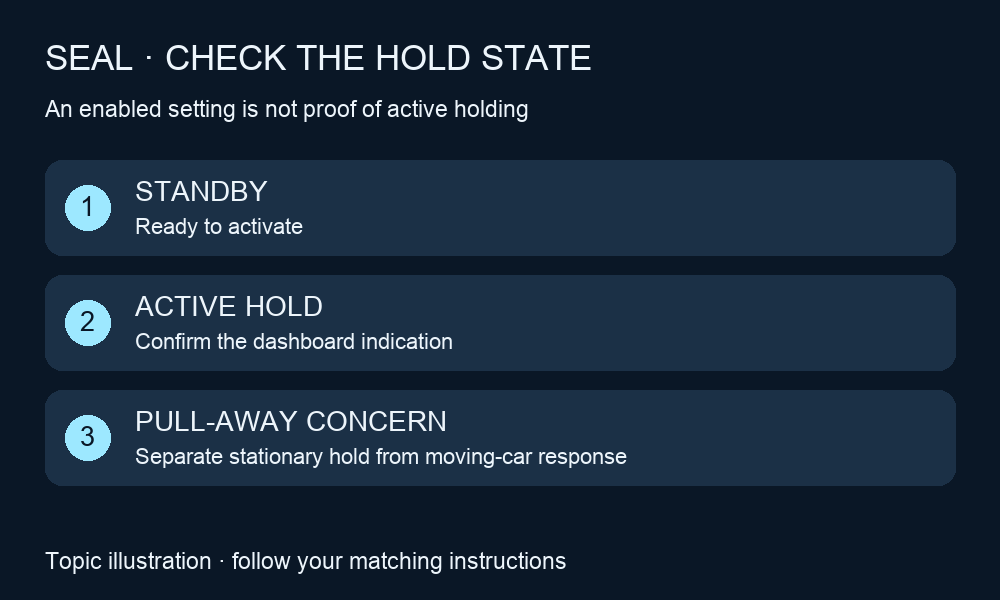
Why is SEAL Auto Hold enabled but the car is not actually being held?
An enabled setting and an active hold are different states. In the EN-250305 RHD handbook, turn AVH on using its switch, with the driver belted, doors closed and braking/EPB systems normal. Keep the footbrake applied until stopped and confirm the active AVH indication before relying on the hold. A standby indication alone does not prove the car will stay still. Keep your foot ready on the brake; do not test by letting the car roll on a slope.
Is a delay pulling away definitely Auto Hold releasing?
No. A UK SEAL Excellence owner described delayed response both at a stop and while already moving. Auto Hold is a stationary-hold function and cannot explain every moving-car response. Record whether the active hold indication was present immediately before the event, whether it happened after reversing, and whether the problem also occurs once the car is moving. Do not press the accelerator progressively harder to overcome a delay or recreate a surge on a public road. Unintended acceleration, failure to slow normally or loss of safe control needs immediate safe stopping and assistance, not reassurance that all SEALs do it.
Why does the SEAL creep after reversing, even with AVH selected?
The checked handbook describes a slow-movement state when reversing or moving slowly forward after reverse, in which AVH remains on standby. That is distinct from an active hold failing. Use the footbrake to control manoeuvring, check the actual indication and follow your matching handbook to leave that state; do not accelerate above a threshold merely to make Auto Hold work in a confined area. Selecting a function is not proof that it is holding.
What should I record and ask to have checked?
Record model year/generation, full build, gear, belt/door state, brake/EPB warnings and AVH indication. Separate three outcomes: never enters active hold; enters then releases unexpectedly; delayed accelerator response with no active hold. Ask the repairer to reproduce the particular state safely and distinguish the AVH/brake-control result from accelerator-response diagnosis. Keep control with the footbrake and arrange assistance if holding or braking is unreliable. When parking or leaving the car, use the prescribed Park/parking-brake procedure; AVH is not permission to leave a vehicle in Drive unattended.
Official SEAL RHD EN-250305 · AVH printed112–113 / PDF113–114
Open sourceUK SEAL owner question about response delay — concern, not a verified diagnosis
Open sourcePRACTICAL NEXT STEP · MyBYD
Your BYD. A clear next step.
Applies to: SEAL RHD EN-250305, printed112–113; later revised SEAL requires matching handbook, not other BYD models.
Evidence checked · Review due
Review is due. Recheck the primary source and your exact version before relying on changing details.
First useful check
While safely stopped, compare standby versus active AVH indication with belt/doors correct; record whether the symptom occurs stationary or already moving.
Read the result
Standby after manoeuvring differs from a failed active hold; a moving-car accelerator concern cannot be explained by stationary AVH alone.
Stop or change approach: Do not provoke rolling, accelerate harder to overcome a delay or continue with unintended acceleration/impaired braking.
Prepare a useful record
Full build and generation, gear/belt/door states, AVH indication, brake/EPB warnings and whether the symptom also occurs while moving.
Keep registration, VIN, account numbers and personal addresses out of this note. Nothing typed here is sent to us or saved automatically. Copy it before leaving the page.
Evidence and answer standard
Documented checks and diagnostic distinctions; owner reports identify concerns, not universal repairs. The date records an evidence review, not a physical test of your car. A forum report can identify a question; it cannot establish a universal repair.
How MyBYD checks owner guidance →