OWNER ANSWER
BYD SEAL alarm going off after locking? Identify the alert first
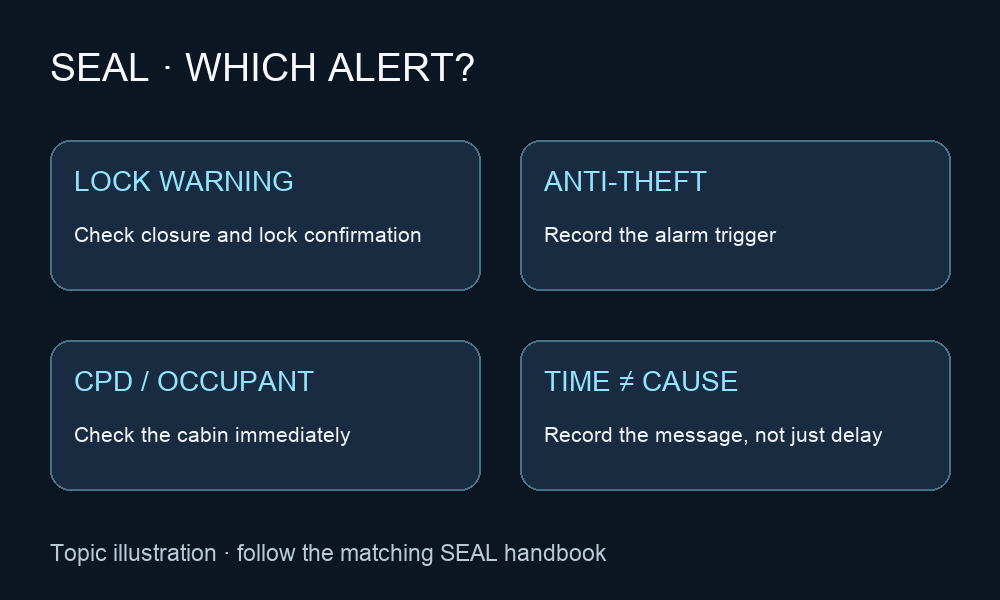
Separate a lock-warning beep, anti-theft alarm and Child Presence Detection; record useful checks and request the right diagnosis for your SEAL.
Jump to a question (8)
Choose a question to open its answer. Read this page’s vehicle scope and safety information before following any steps.
SEAL alarm after locking: what should I do first?
Check immediately that nobody, including a child or vulnerable person, is inside or needs help. Use a valid physical smart key to unlock the vehicle. Do not keep repeating the alarm test. Once everyone is safe, distinguish a brief locking-warning beep from sustained honking/flashing, then check the actual dashboard or app message. This guide covers the SEAL electric saloon using RHD handbook EN-250305, not SEAL U DM-i or SEALION 7; use the matching instructions for a later revised SEAL.
Is one beep on locking an alarm fault?
Not necessarily. The reviewed handbook describes a single locking warning when a door, boot or bonnet is not closed; locking while the ignition remains on also has different confirmation behaviour. Switch off normally, leave nobody inside, check the closure indication and close each panel correctly. A car which does not confirm a secure lock needs a closure check first. Do not repeatedly slam panels, adjust a latch yourself or assume a closed-looking bonnet proves its electrical status input is correct.
Why does it start about 10–15 seconds after locking?
That delay is useful evidence, not a diagnosis. The anti-theft section says arming occurs about 10 seconds after locking, with the indicator changing from steady to flashing. Separately, the CPD section describes an initial locked-car alert within about 10 seconds when it detects life presence. Timing alone cannot distinguish those systems or prove a bonnet switch, cabin sensor or software fault. Record the exact message, indicator behaviour and whether an app/email alert identifies CPD. No notification does not by itself rule CPD out.
Could this be Child Presence Detection rather than the anti-theft alarm?
Yes: the checked SEAL handbook describes CPD honking/flashing and later escalation with air conditioning, separately from anti-theft protection. Look for a CPD/occupant message rather than diagnosing from the sound alone. Its example settings are under Vehicle → Cabin Perception and are described as resetting on the next power-on in that edition; software can change the available settings. Do not treat disabling occupant protection as the repair. The same handbook warns that app unlocking cannot cancel CPD: use the valid physical key/open a door as instructed and check the cabin. Never leave a person or animal inside to test detection.
How can I make one useful comparison without guessing at resets?
Only after checking the cabin and all closures, park safely, switch off normally and use the ordinary physical fob once. Record whether locking is confirmed, the arming indicator changes, the delay and any named alert. If the fault happens only with an already-configured phone key but not the fob, record that distinction with the phone/key type. If all locking methods give the same result, repeatedly switching between fob, NFC, app and handle has not isolated the cause. Stop testing after a repeat; do not disconnect the 12V battery, unplug sensors or install unofficial firmware.
Should I mention a tracker, OBD reader or recent work?
Yes. Record whether anything was fitted or changed before the symptom: an OBD device, tracker, dashcam wiring, door/bonnet work or software installation. SEAL owners have reported alarm behaviour with aftermarket OBD equipment, but those reports do not establish a universal UK repair or prove your device is responsible. Ask the installer/repairer to assess the interaction. Do not unplug hardwired, leased, insurer-required or security equipment, change diagnostic polling protocols or bypass protection on the strength of a forum workaround.
What should the repairer check, rather than just “try an update”?
Send a concise record: exact SEAL generation/year, full vehicle build, whether CPD was named, lock confirmation, warning text, delay, frequency and any recent work/accessory. Ask which system triggered, whether the last alarm cause/event can be retrieved, and for the corresponding closure/sensor status inputs to be monitored. If a repair or update is proposed, ask what finding it addresses and have the original lock-and-arm sequence repeated afterwards. Where no cause is logged, ask for that to be recorded and the next diagnostic step agreed; do not label an unverified part replacement as a confirmed fix.
The update screen says V1.0.0 and “latest”. Is that the cause?
The short label does not identify the full build or show that a particular release applies. Matching released EU/UK BYD versions are owner-confirmed equivalent for the same model/generation/trim/full release, while rollout to individual cars can differ. Obtain the complete build and ask BYD to confirm eligibility and any repair instruction for the observed alarm. Neither “latest” nor another owner’s successful update proves the cause or guarantees the same cure. If the vehicle cannot be secured, arrange assistance or a safe supervised solution with the supplying repairer rather than leaving it unlocked unattended.
SEAL EN-250305 · Anti-theft alarm: printed28 / PDF29
Open sourceSEAL EN-250305 · Lock-warning distinction: printed52 / PDF53
Open sourceSEAL EN-250305 · Child Presence Detection: printed146–147 / PDF147–148
Open sourcePRACTICAL NEXT STEP · MyBYD
Your BYD. A clear next step.
Applies to: SEAL electric saloon, RHD handbook EN-250305, anti-theft printed28/52 and CPD146–147. Not SEAL U DM-i or SEALION 7; later revised controls need matching instructions.
Evidence checked · Review due
Review is due. Recheck the primary source and your exact version before relying on changing details.
First useful check
Check nobody is inside, stop the alert using the valid physical key, then distinguish a single lock warning, named CPD alert and sustained anti-theft symptoms.
Read the result
A closure warning, named CPD response or locking-method difference gives a specific branch; a 10–15 second delay alone does not identify the trigger.
Stop or change approach: Never leave occupants inside for a test, bypass latches or sensors, disconnect the 12V battery or leave an insecure car unlocked unattended.
Prepare a useful record
SEAL year/generation and full build, exact message, lock confirmation, arming indicator, delay, CPD notification, recent work/accessory and recorded trigger if available.
Keep registration, VIN, account numbers and personal addresses out of this note. Nothing typed here is sent to us or saved automatically. Copy it before leaving the page.
Evidence and answer standard
Handbook distinctions and evidence-led diagnostic branches; no single alarm cure established. The date records an evidence review, not a physical test of your car. A forum report can identify a question; it cannot establish a universal repair.
How MyBYD checks owner guidance →